In November 2000 the Alley Theatre
in Houston required a redesign of a crucial effect for their annual production
of A Christmas Carol--

Problem:
The annual production of A Christmas Carol was plagued by a
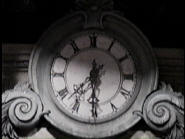
flawed scenic effect in which the hands of a four-foot diameter clock face
prominently centered over the proscenium (figure 1) indicating the rapid
passage of time in support of the play’s narrative consistently failed to stop
at the desired spot. Additionally, the electric motor used to drive the
clockworks did not provide quite enough torque to spin the clock hands
smoothly at all speeds.
|
(figure 1) |
 |
|
Cause:
The accuracy of such an effect is directly attributable to the type of
feedback available to the system. In the existing design, feedback consisted
of a backstage operator watching the clock hands progress via closed-circuit
television monitor-- when the clock hands approached the desired time, the
operator manually flipped a stop switch in hopes that the hands would land at
the desired position. The interface and the inconsistency between operator and
the device proved far too coarse for this application, and routinely caused
errors of “five minutes” or more. Clearly the production suffers if the
narrative and sound effects call for exactly twelve midnight and the visual
representation of time wavers a few minutes in either direction.
Solution:
Installing a PC-based motion control system with electronic position
feedback solves the problem and allows artistic personnel to make more use of
the clock throughout the production. In addition, a computer interface enables
the various clock positions to be saved as electronic data (or cue’s), much as
is done in stage lighting consoles. Specifying and installing a new electric
motor capable of supplying greater torque offers--
- smooth motion at all speeds
- position feedback via a shaft-mounted incremental encoder, and
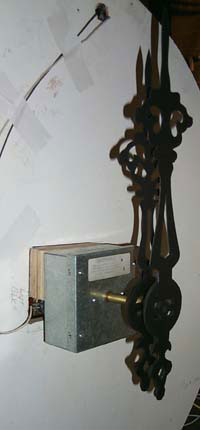
- fits into the existing clockworks enclosure (figure 2).
|
(figure 2) |
|
The control system consists of:
 | a standard Windows PC, running |
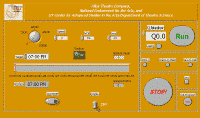
| custom designed software interface developed under the National
Instruments LabVIEW environment (figure 3), in control of
|
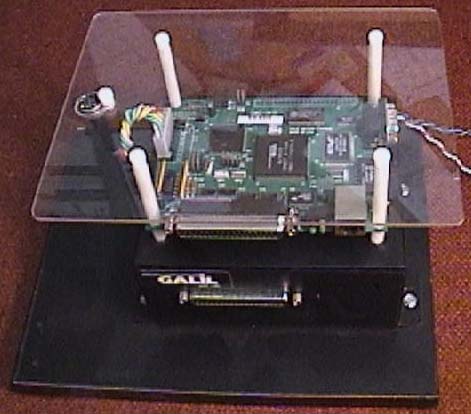
| a Galil 1415 stand-alone servo motor controller and amplifier interface
(figure 4). |
|
(figure 4) |
 |
Conclusions:
Installing a PC-based control system and using a new encoder-equipped
motor allowed servo-positioning control over the effect. The operator could
now write and playback Qs much as with a standard stage lighting console. In
fact, the new control system was so successful, 18 new Qs were added to the
production!
Footnote:
The flood in the Spring of 2001 that devastated much of Houston's cultural
district also destroyed the control electronics that were developed for this
production, As a result, the 2002 version of A Christmas Carol used a
similar operator interface on top of a new four axis controller by National
Instruments.
|