 |
|
|
| Mother of a
Production Davi Napoleon Entertainment Design, Mar 1, 2002 |
|
In the fall of 2001, Chicago spectators experienced a needed catharsis: When going into rehearsal in August, no one at the Steppenwolf Theatre knew how timely an epic play set during an epic holy war would be. Nor did they guess they would use a PC to run the turntable for David Hare's adaptation of Mother Courage and Her Children. Absent were attempts to distance spectators from characters and events, as Brecht once urged. A solid curtain hid the stage before the play began, pierced only by the cry of a lonely cornet behind it. The band performed T-Bone Burnett and Darrell Leonard's original music invisibly, from the pit. Actors changed scenery in costume and in character. And a gasp rose from the mesmerized house when the table began to turn. Revolves are often a technical nightmare, and initial production plans didn't include what usually is a staple for this play. Scenic designer Allen Moyer wanted something fresh, then decided he was shooting down a perfect solution for a stage with a curved apron. “The table works so well for that sense of journey and also to facilitate marching,” he says, adding that pulling the wagon and being able to march in place was a great practical choice for the actors. Technical director Robert McGarvie says they planned to use a treadmill, but that turned out to be expensive and impractical. When the team decided to use a revolve, 32' in diameter, the shop fabricated one from scratch. Aluminum tubing, stress-skinned with plywood, was driven by an aircraft cable wrap and turned by a 5hp winch. The table sat on a crane bearing that anchored it into position on its center point. Normally technicians stop and start the table and determine its direction. This time, a computer program did much of the job, saving and playing back cues much the way a lighting console processes light cues. The big difference is that with actors onstage, motorized scenic effects can be dangerous. Project leader Fritz Schwentker built precautions into the software and figured out when to rely on the PC and when to let the crew cue the table the old-fashioned way. “I set the system up so it could swap into a manual mode,” he says, explaining that he added a cue to reset the turntable to a known position during blackouts. “A computer keeps track of where the turntable is, even if it's running manually.”
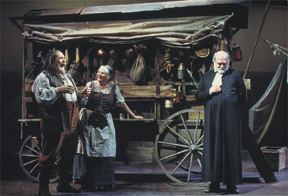 Photo: Michael Brosilow
At the first tech, Schwentker observed the turntable with actors and the wagon on it. When marching actors had to respond to cues from live musicians, it became particularly important for the table to respond to them, and that could only be achieved manually. “We just used the computer as a manual controller,” he says, “so it started the turntable, but the actors could stop where they needed to stop. This is one of the instances where a simpler technology is helpful. [At those times when] we needed a precise position because lights were focused and other scenic elements were onstage, the computer took care of it.” Plans to computerize developed late in the game. Mother Courage was in rehearsal when an NEA grant came through to develop new ways to provide “affordable and manageable automated motion control of a variety of stage scenery effects.” Schwentker, a professor at the University of Texas-Austin, had been experimenting with software, writing control panel front ends for theatrical effects, using a PC to control off-the-shelf electronic components for stage machinery. Steppenwolf knew this would allow technicians more flexibility and, in turn, inspire more artistic experimentation. Although the NEA money wasn't designated for any particular production, the theatre decided to put it to work at once. At the Alley Theatre, Schwentker had arranged for the hands of a clock to move forward and back in time with the touch of a button, which was ideal for that theatre's production of A Christmas Carol. This was the first time Schwentker had attempted anything as complex as a turntable, with an exceptionally large circumference and with actors moving on it. He came to Chicago to do some test runs in the scene shop on winch motors. Using a software-based interface, the LabVIEW development environment from National Instruments in Austin, an operator can control the position and speed for four to 16 linked or independent motion axes of motorized scenery or similar stage effects. “The operator can record, edit, and play back motion cues much as with standard stage lighting consoles,” the proposal to the NEA explained. “The onscreen display offers graphical input and feedback of the control variables. The electro-mechanical components of the effect interface through an industry-standard voltage control signal generated by one or more hardware-based control cards.” Schwentker says the motion control card resides in the PC and does the position feedback control for the electric motors. “Stage effects can be driven by a variety of electro-mechanical, hydraulic, or pneumatic devices and this standard control signal can be used with most.” Electric motors are usually used. “I had to interface the National Instruments control system with the Steppenwolf's existing motor drive cabinets,” he adds, explaining that the idea is to use this new system with existing inventory and all foreseeable purchases. The PC allowed much higher resolution than the Steppenwolf analog control system, and therefore greater position control. A drum with an endless cable loop would clamp a piece of hardware to drive a wagon, tracking back and forth; the PC could provide visual feedback so operators knew where the wagon was onstage. Schwentker says he learned some things he will work with on other projects that will eventually enable the Steppenwolf to build two different systems that will run different motors simultaneously, customized for different kinds of scenery for given productions. For the Brecht play, getting turntable issues out of the way freed the crew and artists to deal with other technical details. The sound design, run manually using two Tascam CD-450 pro CD players and an Akai S-6000 sampler for playing back shorter cues, stressed the theatre's resources. It was both a play requiring localized and realistic sound effects and a musical that required covering the house with speakers and reinforcing music so the actors could respond to cues. “We used petty much every input and output on that board,” sound designer Barry F. Funderburg says. The microphones for the pit were mainly by Shure (KSM44, KSM32, Beta 91, Beta 57, SM-81); the actors wore Shure wireless mics with what the designer refers to as Shure's “top of the line” UHF systems with the new WL50 mic element. With live music — an accordion, cornet, clarinet, baritone, guitar, and drums — Funderburg couldn't do much before techs. He wanted to create a very real and scary war environment, using period explosions and musket fire, as well as environmental sounds; later scenes had cold wind underneath them. Actors were miked only during songs to get them over the pit orchestra. To achieve Kenneth Posner's seamless lighting as it became more intense to underscore the desperation of the characters, 15' × 14' lighting ladders had to be hung from grids on either side of stage for strong side lighting. “We constructed 15' × 14' light ladders and used chain motors to hoist them up to grid,” McGarvie says. Bold flashes of light helped create a panorama of war. Three digitally painted backdrops, created by Alabama-based Tara Graphics, were lit so that the lower half of the upstage wall at times resembled the soil of a rugged terrain, and at other times a body of water. “The designer [Moyer] was looking for photorealism, so we opted not to have a scenic artist paint them,” McGarvie says. A big open wagon dominates a large open space, and the artistic team wanted to show a journey that transpires over more than a decade. Moyer warmed the open space by creating an elegant gold proscenium — an ironic touch, for it framed cannon fire and was pierced with bullet holes. Any wagon would show a lot of wear and tear; this wagon has been through a war. McGarvie says the shop built the wagon from scratch, beginning with wheels made by a wheelwright, then distressed it significantly. The wardrobe department had to devote a good deal of attention to severely distress the not-quite-period costumes James Schuette created to reveal the characters and their poverty. The final moment was nothing short of stunning. Courage stands upstage, alone and slowly wheeling her wagon against the turntable. Offstage, soldiers march and sing. The marching and the singing give way to sounds of war, moving from a palette of period sounds into the that of modern war. At last a Brechtian jolt: We knew where we were and when we were. Funderburg came up with that cue during techs, techs that were in progress on September 11. |
© 2002, PRIMEDIA Business Magazines & Media Inc. All rights reserved. This article is protected by United States copyright and other intellectual property laws and may not be reproduced, rewritten, distributed, redisseminated, transmitted, displayed, published or broadcast, directly or indirectly, in any medium without the prior written permission of PRIMEDIA Business Corp. |