|
Profiles in IT: Fritz
Schwentker
by Belinda
Acosta
--Posted January 17,
2002--
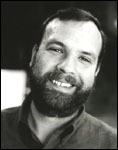 Fritz Schwentker, a professor in the University of
Texas Department of Theater and Dance, develops automated
systems for running scenic effects. This groundbreaking work
is done in association with several regional theaters and will
ultimately create technology that is affordable and accessible
to small and mid-size theaters. Fritz Schwentker, a professor in the University of
Texas Department of Theater and Dance, develops automated
systems for running scenic effects. This groundbreaking work
is done in association with several regional theaters and will
ultimately create technology that is affordable and accessible
to small and mid-size theaters.
Last month, Professor Schwentker sat
down to discuss his research with IT@UT, as eight-month-old
daughter Fritzie sat on his lap.
Tell me a little about your background
and what you do.
By training and by profession, I am a
theater technical director and also a production manager.
Technical directors have to know a little bit of everything. A
technical director is akin to the general contractor and the
consulting engineer on a theater project. We design the
backside of the scenery to make sure it stands up. If it has
to move, we do the mechanical parts behind that, and then all
the organization that's required to get it built: finding
materials, hiring the scenic carpentry staff. The people good
at this job tend to be technically curious; they're the people
looking underneath something to see how it's put together. As
a production manager, we oversee the production heads of the
production: the scenery, costumes, the lights, etc. That's
also what I teach here at UT.
Do you actually work on shows here on
campus or just oversee students working on shows?
At
UT, I oversee students working on shows. I also work on shows
outside UT at different theaters from time to time.
I understand you're doing some
interesting things blending technology with behind the scenes
technical needs. Can you describe your work?
The
research I do, and most of the production work I've done, is
to use PCs to control automated stage equipment and effects,
particularly those things that are run with electric motors on
stage: big things like wagons rolling across stage, turntables
turning, things flying in and out.
I use software, hardware and various
pieces of electronic equipment primarily meant for the process
control industry. Most of that equipment is now relatively
inexpensive, as off the shelf components. Everything is pretty
'smart,' with microchips; they're all networkable. That allows
people doing theater production perform effects that
previously would have been either too expensive or complicated
to put together. The engineering is somewhat simplified by the
fact that there is a broad range of equipment that can be put
in, plugged in and ready to run. I've been using National
Instruments LabView and their motion control hardware to write
HMIs, control panels for running stage effects.
Stage lighting has been computerized for
over 30 years now. You save the set-up of lights in a queue,
and the operator hits a 'Go' button and it executes one light
cue after the next. But there isn't anything commercially
available that's theater specific to support my end of
production.
So, I've used the PC and its programming
environment to develop a variety of ways to control scenery.
We can actually save cues. We may have four or five different
axis of motion, and we can synchronize those and get absolute
position control, which is very important. You need to know
where something is coming from, where it's going, and how fast
so that you don't run people over on stage.
Does this technology allow theaters to
save on manpower, too?
That's a big part of it as
well. You can move (set pieces or scenery) in a variety of
ways. You can have a bunch of people back stage in black
clothing pushing. But if something is big, or needs to move
fast or slowly, then you need to put an electric motor or a
hydraulic piston on it-- in which case, the question becomes,
how do you control it?
For many years, you would put a switch on
stage: for instance, a wagon rolls on stage, and when it hits
the switch it decelerates to a stop. And that's fine, as long
as three people don't happen to get on just as it's about to
stop and it doesn't move far enough. In the technical
rehearsal process, you end up having someone stop and move
that switch physically. With computer controlled equipment you
put a counter on the electric motor, and the computer keeps
track of where the piece is at any given time, and whether
it's moving at the right speed.
You still have a human being paying
attention with a big red mushroom 'STOP' button somewhere on
the system, but it makes it easier to synchronize (scenery
movement)...(especially) if two or more things are moving
simultaneously. It's pretty cool and a lot of fun.
Has your new technology been used here
at UT?
I've done some of this work in productions in
the College of Fine Arts, although most of it I've done in
regional theaters around the country.
What sort of reaction are you getting?
Are you finding that your work is a viable, useful
technology?
Yes, (the theaters) are very excited about
it. Although what I'm doing isn't exactly new to the
entertainment industry. If you go to Broadway or Las Vegas,
this stuff exists. The large scenic and theatrical companies
have built all of it in proprietary format. Those companies
essentially rent their technology to the production.
The regional theaters I work with-they
need to do these same sort of effects, but tend to have less
money to spend. The technical directors are very busy, working
from show to show to show. In a commercial project, people get
together for one project and then they disband. But a
producing theater may do seven or more productions in a season
and the technical staff is working flat out, just to deal with
the physical aspects of it.
The people who do this job don't have the
time to learn technology. I'm at a university, and that's
exactly what we're supposed to do--develop new knowledge. I've
been having a great time working with those people. I go and
do master classes for the staff so they can learn as well.
How long have you been developing this
technology?
I've been working
on this for five or six years. I started out pretty much from
scratch. I had some facility with some of the equipment but
not with the computerized control. I'm not a programmer. I've
learned that as I've been working.
One of the reasons I've used the
development environment I've used is that it's very accessible
to me as a technician. It's set up to do exactly what I'm
doing in theater: instrumentation, process control and factory
automation. It's just been in the last two years that I've had
something I can take to the various theater companies and
install in their production system. They've been great because
they want to use it and they're more than willing to be
testers and offer feedback.
(Chicago's) Steppenwolf Theater and I just
received a grant from the National Endowment for the Arts to
install a system for them. We're hiring a technician who I can
train to use this equipment. We'll be developing a system
that's big enough to do eight different simultaneous motions.
The other cool thing is that I've learned
about interface design. I look at commercial computer
applications and I think, 'That works, this doesn't. Now I
need to think the same way about my work as well.' That can be
hard, when you spend all day staring at it, getting the same
error message. You lose the distance you need. That's why it's
been great working with back stage people in other theaters
because they say things like, 'It would be really great,
Fritz, if I could do da-da-da.' And I can say, 'Oh, I can do
that for you!'
So I suppose, if it hasn't happened
already, you can synchronize all that stage action with the
light board. Yes. There's actually a whole realm of
entertainment technology that's called Show Control. This
would be one subset of that. Lighting control is one part, the
automated moving scenery is another. Pyrotechnics or sound and
audio might be yet another. Show Control would act as a
'master' system to the various other systems which are
'slaves.'
Perhaps some people don't understand how
important timing is in the theater production, especially with
scene shifts? A friend of mine always says it this way: with
automated lighting, if the computer or somebody makes a
mistake, and a light goes wrong, it's like someone shining a
flashlight in your eyes. If one of my things goes awry, it's
like someone hitting you with the flashlight. The level of
control I must have over the number of interlocks and things
is very different than what you need with lighting
equipment.
Continued
1,2
|